

Getting back to running, lifting, or your sport isn’t about waking up one day and deciding you feel ready. Here’s how we actually get you there.
Getting back to running, lifting, or your sport after an injury isn’t about waking up one day and deciding you feel ready. It’s a process, and skipping steps is usually how people end up injured again. So how do we know when someone is truly ready, instead of just hoping for the best?
Here’s how we actually do it.
It Starts With the Evaluation
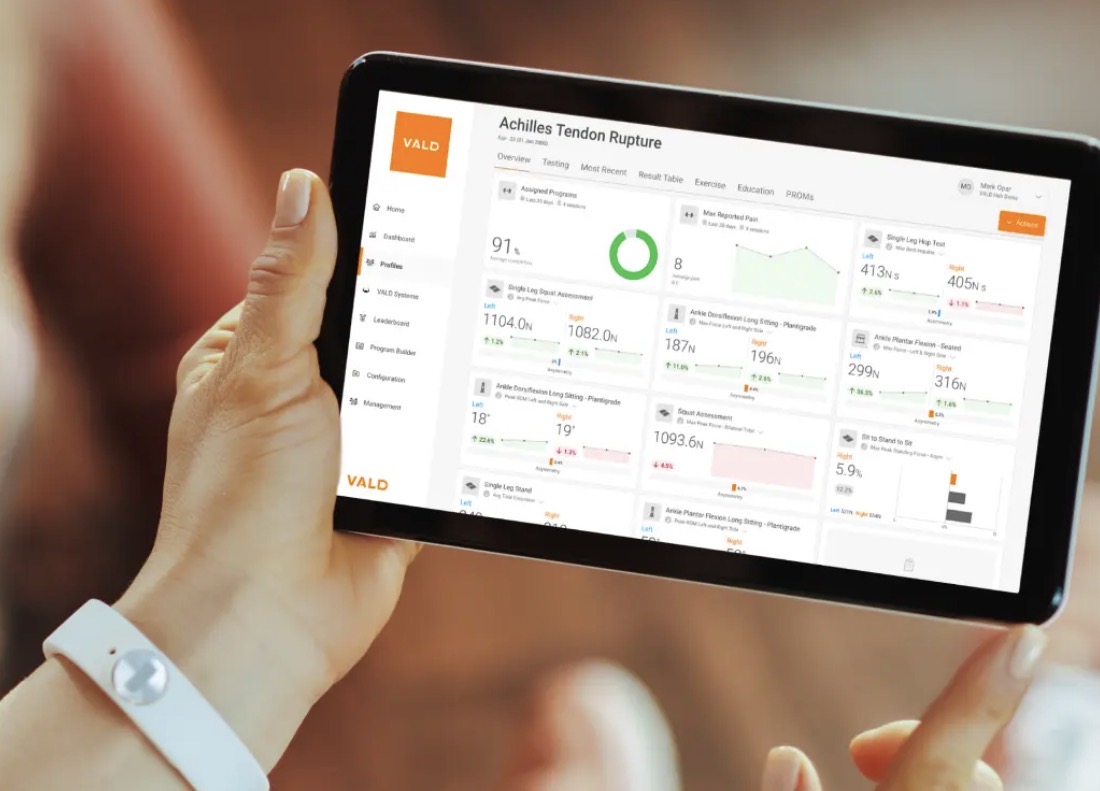
Before we build your plan, we test. Using our VALD Dynamo and ForceDecks, we measure your actual strength, power, and balance, comparing your injured side to your uninjured side. This gives us real numbers instead of a guess, so your plan is built around your body, not a generic timeline pulled from a textbook.
This matters more than people expect. Two people can have the exact same injury and need completely different recovery timelines, because their strength, movement patterns, and tissue response are different. Objective testing shows us those differences from day one.
We don’t guess. We test.
Every return-to-activity plan starts with real data, not a hunch.
Then We Build It in Stages
Your tissue needs time to adapt. That’s not opinion, it’s basic biology. So we don’t rush straight into hard training the moment pain settles down. Instead, we follow your body’s natural healing process, moving through three stages of loading.
Isometrics First
Simple, controlled holds that build strength without stressing the area too much. Think holding a position steady, not moving through it. This is often where recovery starts, especially soon after an injury or surgery.
Eccentrics Next
Controlled, lengthening movements, like slowly lowering into a squat, that build real strength and resilience in the tissue. This stage teaches your muscles and tendons to absorb load safely, which is critical before adding speed or impact.
Higher-Level Activity Last
Running, jumping, cutting, or sport-specific movement, added only once your body has proven it can handle the load. This is the final stage before you’re cleared to go all-in.
This is the same logic behind our CALM, CORRECT, CONQUER approach. Calm the area down, correct the movement pattern, then conquer real-world demands, in that order, never skipped.
Calm
We start by calming down pain and irritation, using hands-on care and targeted treatment so your body can actually do the work of healing.
Correct
Next, we correct the movement patterns that may have caused the problem in the first place, so you’re not just masking symptoms.
Conquer
Finally, we build real strength and resilience, testing your progress along the way so you leave with confidence backed by numbers.
We Don’t Guess When You’re Ready to Move Up a Stage
This is the part most people never get told about their own recovery. Moving from isometrics to eccentrics, or from eccentrics to running and cutting, shouldn’t be based on a calendar or a hopeful feeling. It should be based on proof.
We re-test along the way with the Dynamo and ForceDecks, so every step forward is backed by data. If your numbers say you’re not quite there yet, we adjust the plan instead of pushing you into risk. If your numbers say you’re ready, we move forward with confidence instead of hesitation.
- Strength compared side to side, not just “does it feel okay”
- Power and control measured under real load, not just at rest
- Clear checkpoints before advancing to the next stage
- A plan that adjusts based on your results, not a fixed script
A Real Patient Story
I broke my leg back in March, and by the time my regular PT ended, I could walk fine, but running felt terrifying. Nobody had told me how to know if I was actually strong enough again. At Progressive Mobility, they tested both legs on the force plates and showed me, in real numbers, how much weaker my injured side still was. It wasn’t a guess anymore. We started with simple holds, built up from there, and every few weeks they’d retest me so I could actually see myself getting stronger. By the time I was cleared to run again, I wasn’t just hoping it would go fine. I knew it would. Why didn’t my doctor tell me this was even an option?
Patient Story, shared with permission
This is exactly the outcome we aim for with every patient. Not just less pain, but real proof that your body is ready for what’s next.
The Result
You return to running, sport, or daily life with real proof your body can handle it, not just crossed fingers. That’s the difference between hoping you’re ready and knowing you are.
Common Questions
What is return-to-sport testing?
Return-to-sport testing uses tools like force plates and hand-held dynamometers to measure your strength, power, and balance, comparing your injured side to your uninjured side. Instead of guessing if you’re ready based on how you feel, testing gives an objective, measurable answer before you go back to running, lifting, or your sport.
What is the difference between isometric and eccentric exercise?
An isometric exercise is a muscle contraction with no movement, like holding a squat in place. It builds strength with very little stress on healing tissue, which is why it’s often used early in recovery. An eccentric exercise is a controlled lengthening movement, like slowly lowering into a squat, and it’s introduced once tissue can safely handle more load.
How long does it take to return to sport after an injury?
Timelines vary widely depending on the injury, the person, and how their tissue responds to loading. Rather than relying on a fixed calendar, a good return-to-sport plan is guided by objective testing at each stage, moving forward only when strength and control data show you’re ready, not simply because a certain number of weeks has passed.
Why do I need to be retested during physical therapy?
Retesting shows real progress instead of relying on how you feel that day, which can be misleading. It also identifies exactly when your body is ready to safely handle more demanding exercise, so your plan can advance at the right pace and reduce the risk of setbacks or re-injury.
Ready to Get Back to What You Love?
Find out exactly where you stand, with real testing and a clear plan to safely return to running, sport, or daily life.
