

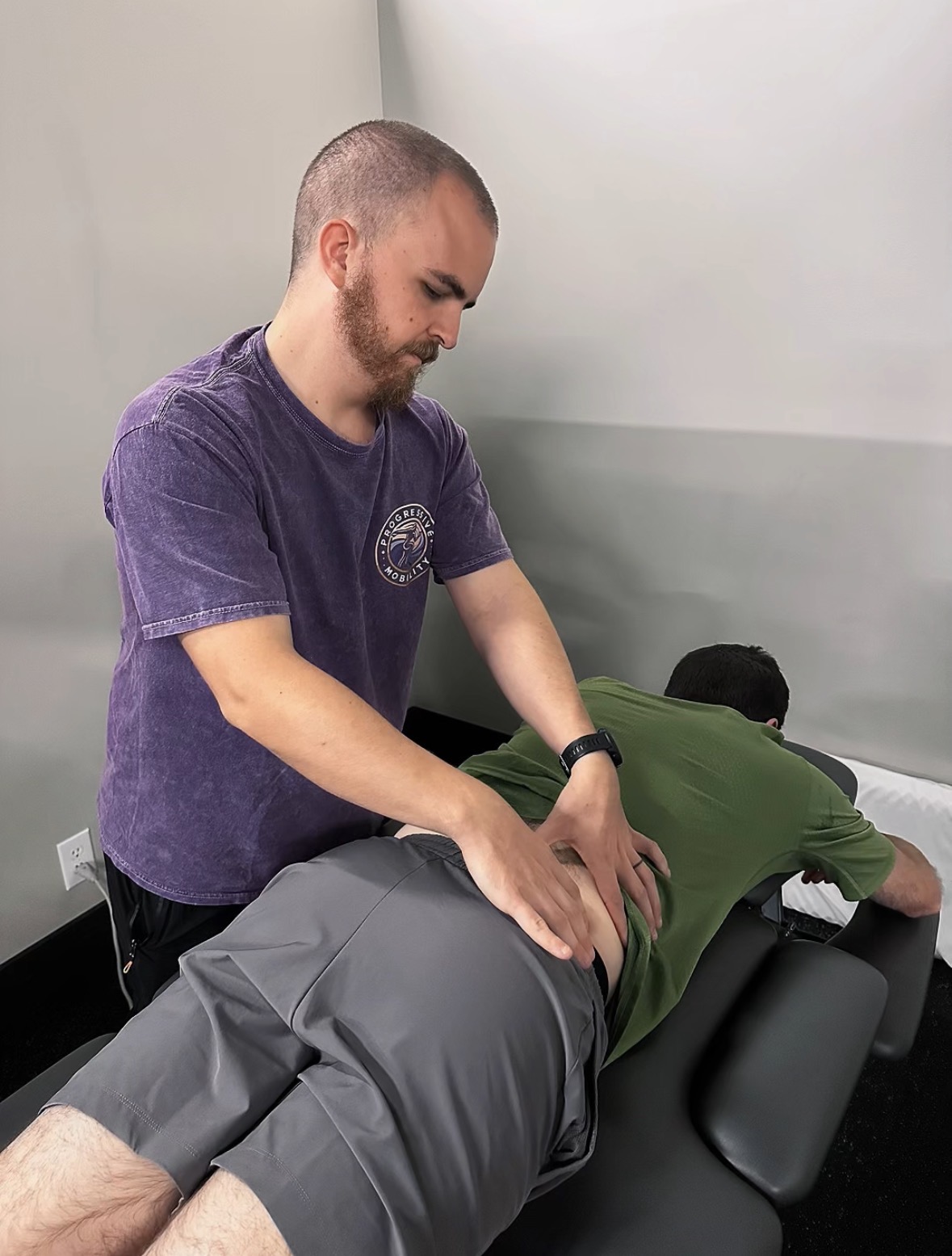
Your hips do more work than almost any other joint in your body. Every squat, every stride, every golf swing, and every step down a trail runs through them. Most people don’t think about their hips until something starts pinching, aching, or feeling “tight.”
This month we’re doing a four-part series on hip health. Before we get into testing, exercises, or what to do when something hurts, it helps to know what you’re working with.
The Bones: A Ball and a Socket
The hip is where your thigh bone (femur) meets your pelvis.
The top of the femur ends in a rounded femoral head, the “ball.” That ball sits in a cup-shaped socket on the side of the pelvis called the acetabulum. Three bones form the pelvis on each side: the ilium, ischium, and pubis. They fuse together during development, and all three meet right at the socket.
This ball-and-socket design lets the hip move in every direction while carrying your full body weight. Walking loads the hip with a multiple of your body weight. Running and jumping load it even more.
What Holds It Together
The bones are only part of the picture.
- Articular cartilage covers the ball and the socket, so the surfaces glide smoothly against each other.
- The labrum is a ring of tougher cartilage around the rim of the socket. It deepens the cup and helps seal the joint.
- The joint capsule and ligaments wrap around the joint. The iliofemoral ligament on the front of the hip is one of the strongest ligaments in the body.
- Muscles control and power the hip: the glutes (maximus, medius, and minimus), the hip flexors, the adductors on the inside of your thigh, the hamstrings, and a group of small deep rotators underneath the glutes.
The bones and ligaments give the hip its stability. The muscles decide how well you use it. That distinction matters later in this series, because muscles are the part you can train.
What Your Hip Should Be Able to Do
The hip moves in six directions:
- Flexion: bringing your knee toward your chest (the bottom of a squat)
- Extension: driving your leg behind you (push-off when you run)
- Abduction: moving your leg out to the side
- Adduction: bringing your leg back across your body
- Internal rotation: turning your thigh inward
- External rotation: turning your thigh outward
Range of motion alone doesn’t make a hip healthy. It also needs strength and control through those ranges, especially on one leg. Here’s what that looks like in the activities you actually do.
Squatting and Lifting
Squatting and lifting take a lot of hip flexion, plus some rotation depending on your stance. The glutes and hamstrings have to control the descent and drive you back up.
Running
Running is a series of single-leg landings. Each time your foot hits the ground, your glute medius keeps your pelvis from dropping to the opposite side. Your hip also needs enough extension to push off behind you. Without it, the low back or knee often picks up the slack.
Golf
Golf depends heavily on hip rotation, particularly internal rotation of the lead hip as you turn through the ball. When the hip can’t rotate, the swing finds that motion somewhere else, usually the low back.
Hiking
Hiking looks easy on the way up. On the way down, your hip muscles work eccentrically, meaning they lengthen under load, to control every step. That’s often where weakness shows up.
Why Your Squat Doesn’t Have to Look Like Anyone Else’s
Socket depth and angle vary from person to person. So do the angle of the femoral neck and the direction the ball points into the socket. These differences are built into your bones, and no amount of stretching changes them.
That’s why one person can squat deep with a narrow stance and toes forward, while someone else pinches at parallel in that same position. The second person isn’t necessarily tight or doing it wrong. Their hips may simply be built for a wider stance or more toe-out.
So a single “correct” squat stance for everyone doesn’t exist. A good plan works with the hips you have and doesn’t force you into someone else’s position.
Where Hip Pain Shows Up and What That Hints At
Location is one of the first clues we look at:
- Front of the hip or groin is often related to the joint itself or the structures around the socket.
- Side of the hip often involves the tendons of the glute muscles that attach there.
- Back of the hip or buttock can come from the hip, but it’s also a common place for the low back to refer pain.
Pain in the hip region doesn’t always come from the hip. That’s one reason a thorough assessment looks above and below the painful spot, not just at it.
What’s Next?
Now you know what’s inside the joint and what it’s supposed to do. Next Monday, in Part 2, we’ll walk through simple tests you can do at home to check your own hips and figure out whether something deserves a closer look.
